
How a septic system works
Short answer
A septic system treats household wastewater on your own property. A buried tank separates solids from liquid, then the liquid flows to a leach field, where it soaks into the soil. The soil removes most harmful bacteria, viruses and nutrients.
A conventional septic system comes down to two parts: a septic tank and a leach field (you'll also hear drain field or soil absorption field). The simplest designs run on gravity alone. Bacteria and soil do the treating.
Wastewater leaves the house
Toilets, sinks, showers, the dishwasher and the washing machine all drain into one main pipe. That pipe slopes from the house down to the septic tank.
The tank separates solids from liquid
The septic tank is a sealed, buried container, usually concrete, fiberglass or polyethylene. Wastewater sits in it long enough to settle into three layers:
- Scum: fats and oils float to the top.
- Liquid: the middle layer, called effluent. It's the only part meant to leave.
- Sludge: solids sink to the bottom.
Bacteria break down some of those solids. Not all of them, though, and the rest keeps building up, which is why every tank needs pumping from time to time.
Liquid leaves through the outlet
Compartments and a T-shaped outlet hold the sludge and scum back so that only liquid moves on. When solids do escape, they can clog the leach field.
On many systems the liquid next reaches a distribution box, which splits the flow between pipes. Some systems use a pump or other devices at this point instead.
The leach field spreads the liquid
The leach field is a shallow, covered area of unsaturated soil. Perforated pipes or chambers release the liquid across the whole area, so no single spot takes all the flow.
Leach field or drain field?
Same thing, different names. You may also see "soil absorption field", "drainfield" or "septic field".
The soil finishes the treatment
As the liquid percolates down, the soil accepts it, treats it and disperses it. Along the way it removes harmful coliform bacteria, viruses and nutrients.
All of that depends on the soil being able to take the water. Send too much liquid to the field and it can flood. Sewage may then surface in the yard or back up into toilets and sinks. See the warning signs.
How other systems differ
Everything above describes a conventional system. Aerobic treatment units add oxygen to speed treatment up, and other alternative designs exist for sites with poor soil or a high water table. Because these systems often have mechanical parts, they usually need checking more often.
Rules vary by location
Which systems are allowed on a property depends on state and local rules. Your local health or environmental department is usually the permitting authority, and it may hold a record drawing of your system.
Sources
- How Septic Systems Work, US EPA
- About Septic Systems, US EPA
- Types of Septic Systems, US EPA
Read next
-
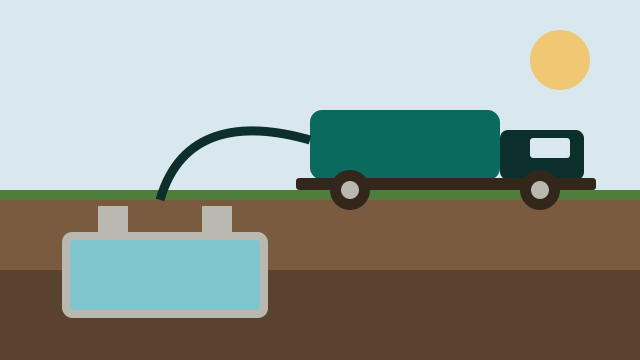 How often should you pump a septic tank?
Most household septic tanks are pumped every three to five years. See what changes that schedule and how to tell when your own tank is due.
-
 Signs of a failing septic system
Sewage backups, slow drains, wet ground and odors can all point to a septic problem. Learn what each sign may mean and what to do first.