
How deep is a leach field?
Short answer
There is no single depth. Ohio State University Extension describes trenches about 18 inches deep, while an EPA fact sheet gives a typical range of 1 to 5 feet. Drip tubing can sit in the top 6 to 12 inches of soil. Your county's permit record is the best source for your own system.
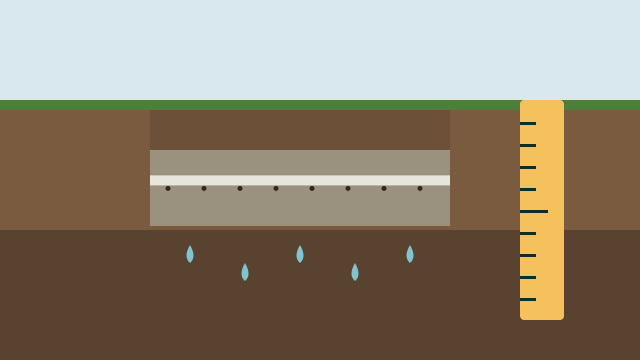
It depends on the system type, the soil and your local rules. A general figure will only get you close, but the published ranges below show what's typical.
Typical leach field depths
| System | Depth | Source |
|---|---|---|
| Conventional trench | About 18 inches | Ohio State University Extension |
| Trenches in general | About 1 to 5 feet | EPA fact sheet, 1999 |
| Low-pressure dosed ditches | About 9 to 12 inches | EPA fact sheet, 1999 |
| Drip tubing | Top 6 to 12 inches of soil | EPA |
| Minnesota trench or bed | Bottom no deeper than 48 inches, with at least 12 inches of soil cover | University of Minnesota |
Some parts sit much closer to the surface than that. University of Florida Extension warns that pipes can be just a few inches down, and advises against digging below 6 inches anywhere in a drain field.
Why are leach fields so shallow?
Because the soil has to do the treating. The field needs to stay in unsaturated soil, with enough distance above groundwater or rock for that treatment to happen, and going deeper eats into the distance. Where the water table is high or the soil is shallow, designers may use a shallow system or build a mound instead.
How much soil needs to be under the field?
Each state sets this distance, called vertical separation, and the numbers vary more than you might expect:
- North Carolina: 12 to 18 inches of unsaturated soil below the trench bottom
- Ohio: at least 18 inches on most sites, with soil at least 36 inches deep before a limiting layer
- Minnesota: at least 3 feet for standard systems
- Pennsylvania: at least 4 feet below the gravel layer to the groundwater table or bedrock
An EPA fact sheet says state rules usually call for about 2 to 4 feet, and sometimes less.
How can you find the depth of your own field?
- Ask your county health department for the permit file. The University of Georgia notes that records may show a system's location, type, length and depth, although very old ones can be incomplete.
- Check your home's paperwork for a site plan.
- Ask a septic professional to confirm it on site.
Before you dig
Don't dig, drive stakes or trench near a leach field until you know where the lines are. Call 811 first to have buried utilities marked. Soil near a field may contain sewage, so wear gloves and wash up afterward.
Rules vary by location
Trench depth, soil cover and separation rules are set locally. For any planning, use your state or county rules, not the examples here.
Quick answers
How deep are leach field lines?
Often around 18 inches, but published depths run from a few inches to several feet.
Sources
- Septic Tank: Soil Treatment System (AEX-743), Ohio State University Extension
- Decentralized Systems Technology Fact Sheet: Septic Tank - Soil Absorption Systems (1999), US EPA
- Types of Septic Systems, US EPA
- All about septics, University of Minnesota Onsite Sewage Treatment Program
- Landscaping on or near Septic Drain Fields, University of Florida IFAS Extension
- Why Do Septic Systems Fail?, NC State Extension
- Septic System Basics, Penn State Extension
- A Beginner's Guide to Septic Systems (Bulletin 1421), University of Georgia Extension
Read next
-
 What is a leach field?
A leach field, or drain field, is the buried part of a septic system that spreads liquid into the soil for treatment. Learn how it works and what harms it.
-
 How to find your septic tank
Find your septic tank using county records, the sewer pipe's exit point and a careful probe. Learn the steps, and when to call 811 before you start.
-
 Replacing a leach field and what it costs
Published guides put drain field replacement at about $3,000 to $15,000, and mound fields higher. See what drives the price and what the job involves.