
What is a leach field?
Short answer
A leach field, also called a drain field or soil treatment area, is a shallow network of buried pipes or chambers that spreads liquid from the septic tank into unsaturated soil. The soil then treats the water by removing harmful bacteria, viruses and nutrients. "Leach field" and "drain field" mean the same thing.
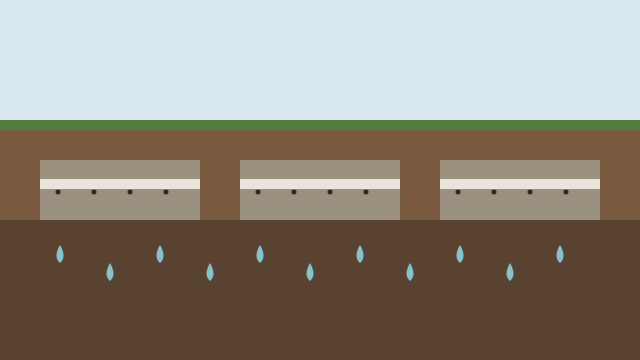
A leach field finishes the job the septic tank starts. The tank separates solids from liquid. The leach field then sends that liquid into the ground, where the soil treats it.
What's the difference between a leach field and a drain field?
There isn't one. Leach field, drain field, drainfield, leach lines, absorption field and soil treatment area all name the same part of the system. Which one you see mostly depends on the region or the document.
How does a leach field work?
- Liquid, called effluent, leaves the septic tank through an outlet.
- On many systems, a distribution box divides the flow between lines.
- Perforated pipes or plastic chambers release the liquid along shallow trenches.
- The liquid soaks into unsaturated soil.
- As it moves down, the soil and its microbes remove harmful bacteria, viruses and nutrients before the water reaches groundwater.
That last step needs air spaces in the soil. When soil stays saturated, the field can't accept or treat water properly.
What does a leach field look like?
From the surface, a healthy field usually looks like ordinary lawn. Underneath, a conventional field is a set of trenches, each holding gravel or chambers with fabric and soil on top.
How big is it? Ohio State University Extension says a three-bedroom home's system can be up to 138 feet long, depending on soil and site, usually split into sections. Sizes vary a lot, though, and your permit record is the only reliable guide to yours.
Types of leach field
| Type | How it spreads water | Where it's used |
|---|---|---|
| Gravel trench | Perforated pipe in a stone-filled trench | Sites with enough suitable soil and space |
| Chamber | Connected plastic chambers with no gravel | High water tables, variable flows, areas short of gravel |
| Drip | Small tubing in the top 6 to 12 inches of soil | Many field types, but needs a dose tank and power |
| Mound | A trench inside a built-up sand mound | Shallow soil, high groundwater or shallow bedrock |
How long does a leach field last?
There's no fixed lifespan. What the EPA does say is that a biomat, the slimy layer that forms in the field, can thicken once a field is more than 25 to 30 years old and cut how much water it can discharge. At that age, the EPA advises owners to start planning an upgrade before it turns into an emergency.
What damages a leach field?
NC State Extension names these common causes of failure:
- Too much water. Leaks, extra appliances and sump pumps can overload the system.
- Runoff. Water from roofs, roads or paving can saturate the soil.
- Skipped pumping. Solids that escape the tank clog the soil pores.
- Physical damage. Driving or building over the field can crush pipes and compact soil.
- Roots. Tree roots can clog the lines.
How do you protect one?
Most of it is about keeping weight and extra water off the field:
- Keep cars and heavy equipment off it.
- Send roof drains and sump pumps away from it.
- Plant trees at a safe distance. A septic professional can advise on yours.
- Check with your permitting authority before building anything on it.
- Keep the tank pumped on schedule.
Stay safe
Wet spots, standing water or sewage odors over the field? Keep people and pets away, because surfacing wastewater can spread disease. See the signs of a failing system for what to do first.
Rules vary by location
Your state and county set the design and repair rules for leach fields. Ask your local health department before changing anything.
Quick answers
Is a leach field the same as a septic tank?
No. The tank separates solids from liquid, and the leach field releases that liquid into the soil.
Can you park on a leach field?
No. The EPA says not to park or drive on one, because vehicles can damage the system.
Sources
- How Septic Systems Work, US EPA
- Types of Septic Systems, US EPA
- How to Care for Your Septic System, US EPA
- Frequent Questions on Septic Systems, US EPA
- Why Do Septic Systems Fail?, NC State Extension
- Septic Tank: Soil Treatment System (AEX-743), Ohio State University Extension
Read next
-
 How deep is a leach field?
Many leach field trenches sit about 1.5 feet down, but depth runs from inches to several feet. See typical depths and how to find your own.
-
 Replacing a leach field and what it costs
Published guides put drain field replacement at about $3,000 to $15,000, and mound fields higher. See what drives the price and what the job involves.
-
 Signs of a failing septic system
Sewage backups, slow drains, wet ground and odors can all point to a septic problem. Learn what each sign may mean and what to do first.