
Septic system diagram with every part explained
Short answer
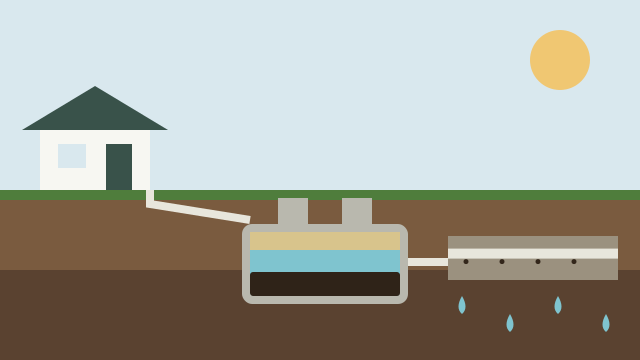
A conventional septic system has four main stages. A pipe carries wastewater from the house to a buried tank. The tank separates solids from liquid. Liquid then flows, often through a distribution box, to a leach field. There, pipes or chambers release it into the soil for final treatment.
Both drawings below show a conventional gravity system. Treat them as a general picture: your own layout may differ, and your permit record is the place to find where things really sit on your property.
Side view
This cut-away follows the water from the house down into the soil.
Top view of a typical yard
From above, under the lawn, the same system might look like this. According to the University of Georgia, the tank is often 10 to 20 feet from the house, in line with the sewer pipe.
What does each part do?
| Part | What it does |
|---|---|
| Building sewer | The main pipe carrying all wastewater out of the house |
| Septic tank | Holds wastewater so that solids sink as sludge and fats float as scum |
| Baffles or tees | Slow incoming water and keep scum and solids from leaving |
| Lid or riser | Gives access to the tank for pumping and inspection |
| Effluent filter | On some tanks, catches small solids at the outlet |
| Distribution box | On many systems, divides the flow between leach lines |
| Leach field | Pipes or chambers that release liquid into the soil |
| Soil | Removes harmful bacteria, viruses and nutrients |
How do other system types differ?
The tank stage looks much the same on most systems. It's what happens after the tank that changes:
- Mound systems add a pump chamber and build the field in a raised sand mound, for shallow soil or high groundwater.
- Aerobic systems add oxygen to a treatment tank, and some finish with a tank that disinfects.
- Drip systems add a dose tank and timed pumping to feed tubing near the surface.
- Chamber systems swap the gravel for connected plastic chambers.
Want the step-by-step version? Read how a septic system works.
Rules vary by location
Your county may hold a drawing of your own system. Ask your local health department for the permit file.
Sources
- How Septic Systems Work, US EPA
- Types of Septic Systems, US EPA
- A Beginner's Guide to Septic Systems (Bulletin 1421), University of Georgia Extension
Read next
-
 How a septic system works
Follow wastewater from your house through the tank, leach field and soil, and see how a conventional septic system treats it underground.
-
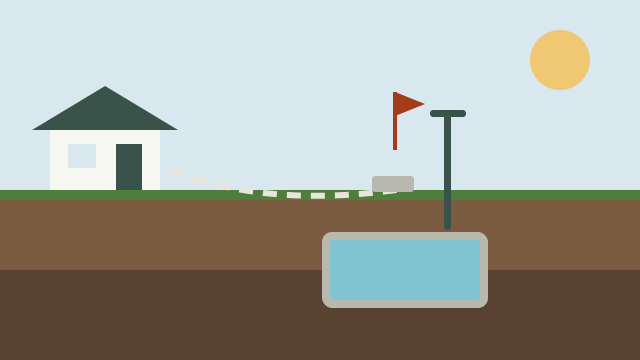 How to find your septic tank
Find your septic tank using county records, the sewer pipe's exit point and a careful probe. Learn the steps, and when to call 811 before you start.
-
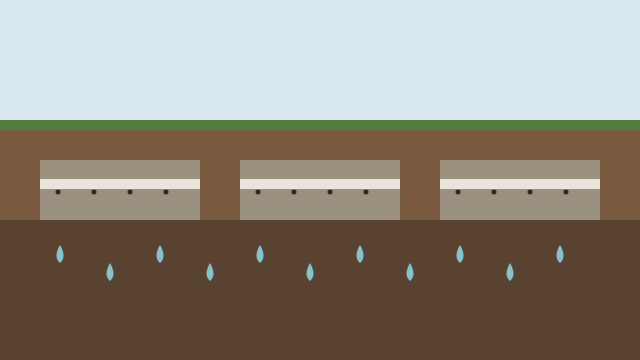 What is a leach field?
A leach field, or drain field, is the buried part of a septic system that spreads liquid into the soil for treatment. Learn how it works and what harms it.